Header

Search
  • Our mission is to better understand brain development to improve support of individuals with developmental or learning disorders such as autism, dyslexia and dyscalculia.
  • deco

    Causes of learning deficits and development delay

    We aim to establish causal links between learning deficits or development delay and impaired brain circuit adaptation during behavior. Further, we aim to identify genetic factors contributing to mild learning impairment. (Picutres: Helmchen lab (left) and Ruff lab (right)).

  • deco

    From molecules to behavior

    We aim to uncover molecular mechanisms underlying brain circuit development. Further, we want to identify mutations affecting circuit formation and multi-sensory processing. (Picture: Alexandre Dumoulin, Stoeckli Lab, UZH)

  • deco

    Translational research for better patient care

    We aim to translate insights from basic research to the clinic and to develop new diagnostic tools as well as innovative treatment strategies. (Picture: Children's Hospital Zurich)

  • deco

    Microscopy Innovation Platform (MIP) – Pushing the boundaries of effective resolution

    Building on the success of our mesoSPIM microscopes, we drive cutting-edge innovation across a wide range of light microscopy technologies.Further, we provide expertise and service for UZH researchers interested in using our microscopes, which allow high-resolution 3D imaging. (Pictures: mesospim.org)

  • deco

    Platform: Innovative high-dimensional data science (HDDS)

    We aim to develop innovative algorithms for analysis of data from microscopy, functional imaging or behavior videos. (Picture: Sepp Kollmorgen, Platform manager, UZH)

  • deco

    Platform for learning and learning disorders (LLD)

    The platform aims to foster efficiency of collaborative research projects and to ensure effective dissemination of scientific knowledge by providing educational activities, information, and materials on learning disorders for different stakeholders. Further, we provide dyslexia assessement.

Adaptive Brain Circuits in Development and Learning

Discover the brain and our multidisciplinary research
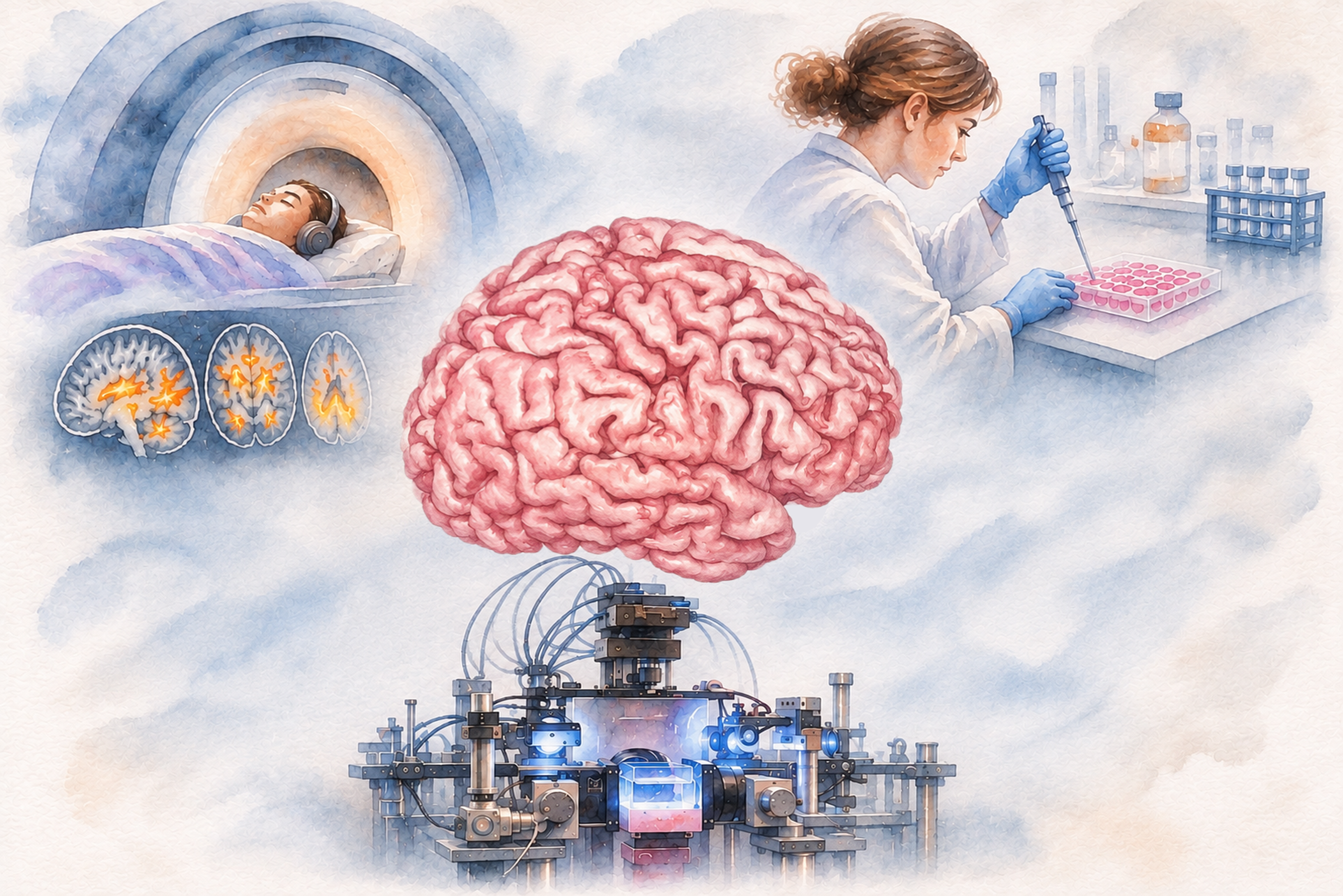
Illustration generated with ChatGPT (OpenAI, 2026), adapted by the author.

The brain is an incredibly complex yet essential organ. It enables us to think, feel, learn, remember, and interact with the world around us. Understanding how it works therefore requires looking at it from many different perspectives and combining insights from a wide range of disciplines.

Our University Research Priority Program (URPP) AdaBD takes exactly this multidisciplinary approach. Our research spans a broad spectrum of approaches to explore the mechanisms underlying various neurodevelopmental conditions: from studying the fundamental mechanisms of individual nerve cells in petri dishes and investigating animal behaviour through experiments, to using advanced imaging techniques such as functional magnetic resonance imaging (fMRI) to observe brain activity in humans. 

To give you a glimpse into the fascinating complexity of the brain and the diversity of research conducted within our programme, we invite you to explore the video series below. They offer fascinating insights into the human brain, the methods we use to study it, and the work of our scientists.

Watch our videos

Schau unseren Forschenden bei der Arbeit zu (in German, English subtitles will follow) 
Reise durchs Gehirn (in German, English subtitles will follow)
 

Additional Information